writing
On The New Transcendence
Glenn Adamson
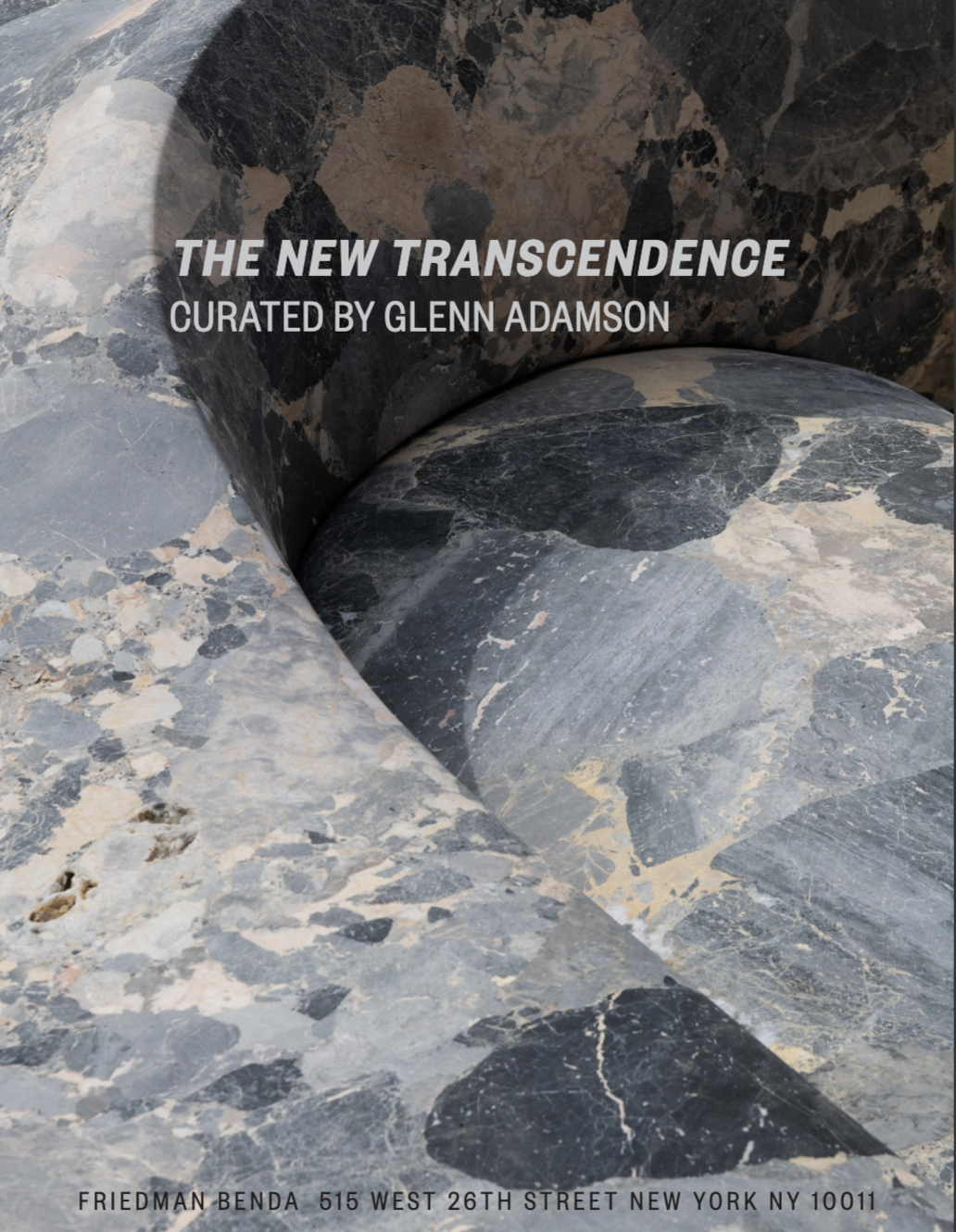
"Self-transcendence is the starting point of Black resistance."
So says Stephen Burks, reflecting upon the traumatic yet awe-inspiring history of the African-American experience.
He frames the accomplishments. of his forebears, who overcame such unknowable hardships, as powerful acts of spiritual self-preservation.
The diasporic situation, as Burks analyzes it, is like an inverted version of Abraham Maslow's famous pyramid of the hierarchy of needs.
In the absence of sufficient food, shelter, and bodily safety, people of African descent have often sustained themselves on spirit alone, a philosophy expressed in song and language and handed down over generations.
In acknowledgment of this past, he affirms, "We believe our ancestors are always with us."
This powerful idea animates his new body of work, simply entitled Ancestors.
It marks an important paradigm shift. Previously, over the course of his career, Burks has essentially operated as a product designer, albeit one with a socially expansive conception of that role. (Indeed, he was the first African-American to achieve broad success in the field.)
Most often, he establishes close working relationships with company artisans, collaborating with them to develop novel techniques and forms.
It is an innovative craft-based strategy, but also client-focused, responsive to a given set of existing possibilities.
Now, however, he is departing from such commercial design briefs, striking out on his own - an approach perfectly suited to his recent ceramics design fellowship at Brooklyn's new fabrication hub, Powerhouse Arts.
The new project builds upon a recent series of experimental objects, commissioned by the High Museum of Art as part of his traveling mid-career survey Shelter in Place.
Created during the summer of 2020, during the pandemic lockdown, these gave form to pressing social issues, particularly in reaction to the Black Lives Matter protests.
Burks showcased his hands-on inventiveness in dealing with subjects like ancestry, grief, loss, and self-care.
As it happens, the dialogue between the analogue and the digital is also intrinsic to the Ancestors.
Their strong, silhouetted forms are generated in an expanded structure of authorship, initially using an improvised algorithmic image generator.
Burks encouraged the Al to make decisions based on a range of prompts and original artwork, as well as photos of prominent African-Americans including Malcolm X and bell hooks.
He then translated these machine-made images into 3D prototypes, altering their characterization, testing their scale, essaying various materials.
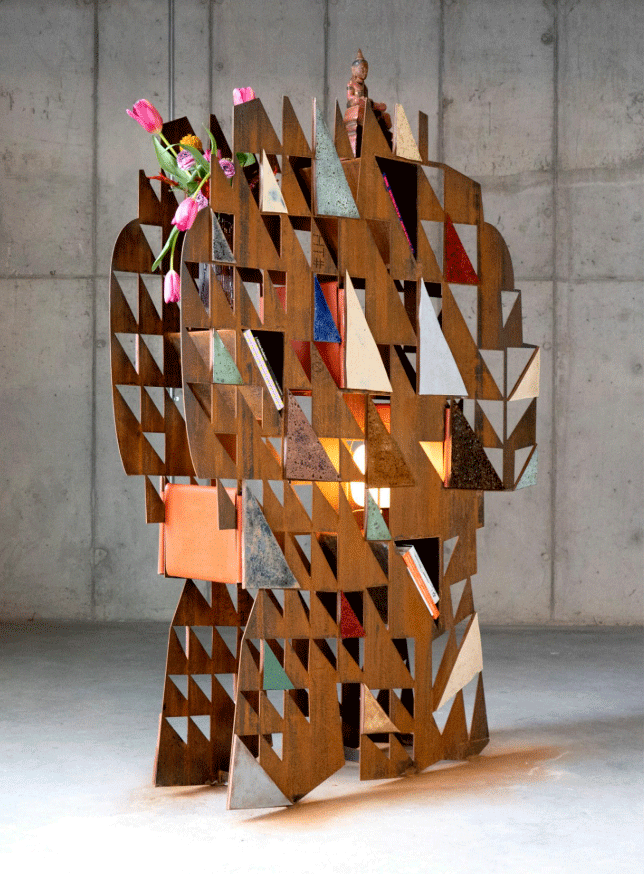
The work included in The New Transcendence is the first finished object from the series.
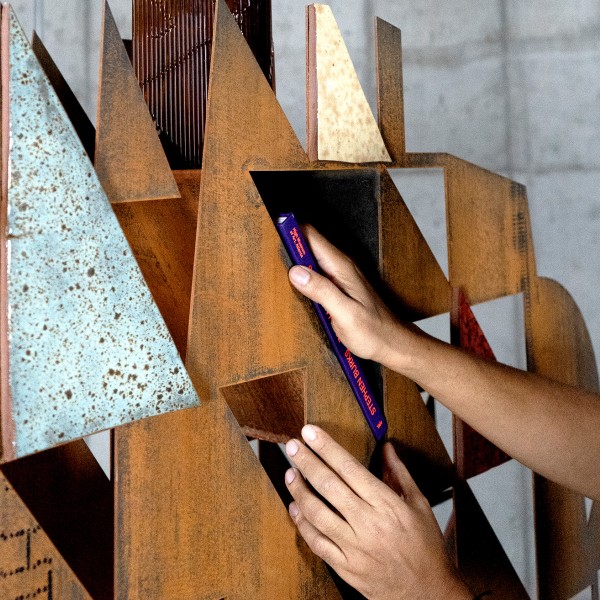
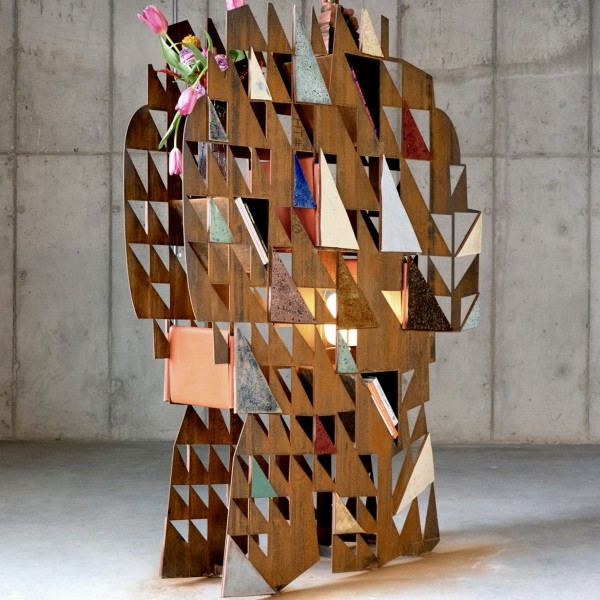
Entitled Ancestors (Guardian), it is made in Cor-ten steel and ceramic and stands some six and a half feet tall - the height of a person.
It stands as both a boundary and a threshold, establishing connection across several domains: past and present, handmade and automated, figurative and abstract, sculptural and utilitarian.
All these dichotomies seem to fall away when contemplating the work, in favor of a singular encompassing gesture: one of respect for the divine, bound inextricably with material possibility.
Read more on our work with ancestry in Najha Zigbi-Johnson's essay Ancestry in the Making in Disegno 38
Read more on our work designing for spirituality in Najha Zigbi-Johnson's essay On New Cosmologies
-
Learning From Raffia, 2026Words Malika Leiper, Photographs Emna Kayouli for Disegno 42September 14, 2026
-
Birth Lounge Chair, 2026Haworth x Stephen Burks Man MadeJune 8, 2026
-
Birth Lounge Chair (Malika), 2026Haworth x Stephen Burks Man MadeJune 8, 2026
-
Birth Lounge Chair (Stephen), 2026Haworth x Stephen Burks Man MadeJune 8, 2026
-
Dinamica Lighting (Ceiling), 2026Haworth x Stephen Burks Man MadeJune 8, 2026
-
Dinamica Lighting (Floor & Table), 2026Haworth x Stephen Burks Man MadeJune 8, 2026
-
Haworth Integration, 2026Haworth x Stephen Burks Man MadeJune 8, 2026
-
Haworth Introduces Stephen Burks Man Made, 2026NeoconJune 8, 2026